You are not buying plowing
Residential snow service is a convenience. Commercial snow service is risk management, and the two get quoted like the same product far too often.
If you manage a clinic, a retail center, an office building, or an HOA, the thing that can actually hurt you this winter is not an unplowed lot. It is one person going down on ice in your parking lot, and the question that follows: what was your service standard, and can you show it was followed. A commercial contract that does not answer that question is a cheap contract that is not doing its job.
Here is what belongs in one, based on the sites we run across Wright and Hennepin counties.
A service standard, written down
The first thing to pin down is what triggers work, and commercial has two fundamentally different models.
A trigger-based contract dispatches at a set accumulation, often one or two inches, the same way residential works. It is the cheaper option and it is appropriate for sites with low foot traffic, warehouse and industrial properties, or anywhere a few hours of snow on the lot is not creating exposure.
Zero tolerance means crews maintain the property continuously through an event rather than making one pass after it ends. Equipment is on site while it snows. That is a materially different cost structure, and for medical buildings, restaurants, senior housing, and anywhere the public walks in and out during a storm it is usually the right call. The distinction matters legally as much as practically, since your standard of care is whatever your contract says it is.
Whichever model you choose, the document should specify the trigger depth, the response window after that trigger, and what the finished condition looks like. Vague language helps nobody once something goes wrong.
The map, not just the address
A residential quote is a driveway. A commercial quote should be a walked site with specific areas identified, because the parts of your property that carry the most risk are rarely the parts that take the most time.
What should be named explicitly in the scope:
- Building entrances and the approach to each one, including secondary and employee doors that get forgotten.
- Accessible parking spaces and the striped access aisles beside them. These are the highest-exposure square footage on any commercial property and they are also the most commonly skipped, because an access aisle looks like empty pavement to a plow driver who has not been told what it is.
- Fire lanes and hydrant access, which are a code issue independent of anything else.
- Sidewalks, including any public walk fronting your property that the municipality makes you responsible for.
- Loading docks, dumpster enclosures, and drive-through lanes, all of which need clearance that a general lot pass does not provide.
- Stairs, ramps, and any exterior transition where footing changes.
Timing gets attached to that map. A clinic opening at 7am needs the lot and entrances finished before 7am, not started at 7am, and that gets scheduled backward from your operating hours rather than forward from when the storm stopped.
Ice is the part that actually costs money
Most slip and fall claims do not come from snow. They come from ice, and ice mostly comes from meltwater going somewhere and refreezing.
This is why pile placement is a design decision made before the season starts rather than a choice a driver makes at 3am. A pile in the wrong corner drains across a traffic lane during a February thaw and refreezes overnight into a sheet nobody expects, right where cars park and people step out. We map piles in advance for exactly this reason, along with which parking spaces you are willing to lose, because a pile costs you spaces and you should choose which ones rather than discover them.
Anti-icing before an event, applying product to dry pavement so ice cannot bond, is worth understanding as a strategy. It uses less material than breaking a bond after the fact and it is the difference between a manageable morning and a scramble. Sites with a low spot that ices every year usually have a drainage or pile problem with a fixable cause, and it is worth finding it in October.
Where a lot is tight or piles have nowhere to grow, hauling snow off site is the release valve. It costs real money and it is cheaper than losing a third of your parking through March.
The documentation is the deliverable
This is the part that separates a real commercial contract from a truck showing up.
You should receive a record of every event: what was serviced, when crews arrived and left, what was applied, and the conditions at the time. We send email confirmation after every event, and on commercial properties that record is not a courtesy. It is the file you hand your insurer or your attorney if a claim ever lands, and it is close to the only evidence that your service standard was met on a specific morning eight months earlier. Nobody remembers the details of a Tuesday in January. A timestamped record does.
Two more items belong in the same conversation. Get a certificate of insurance from your contractor before the season and confirm the coverage is real and current. And establish one named contact on each side plus an escalation path, so a problem at 5am has somewhere to go that is not a general voicemail box.
Seasonal or per event
For commercial the budget question usually decides this. A seasonal contract is one number for the winter regardless of what falls, which is what most property managers want because it goes into the operating budget cleanly and does not produce a surprise in a heavy February. Per event bills each visit and rewards you in a mild winter while exposing you in a hard one.
Neither is a trick. It is a straightforward question of whether you would rather have predictability or take the weather risk yourself, and how much a bad month would hurt.
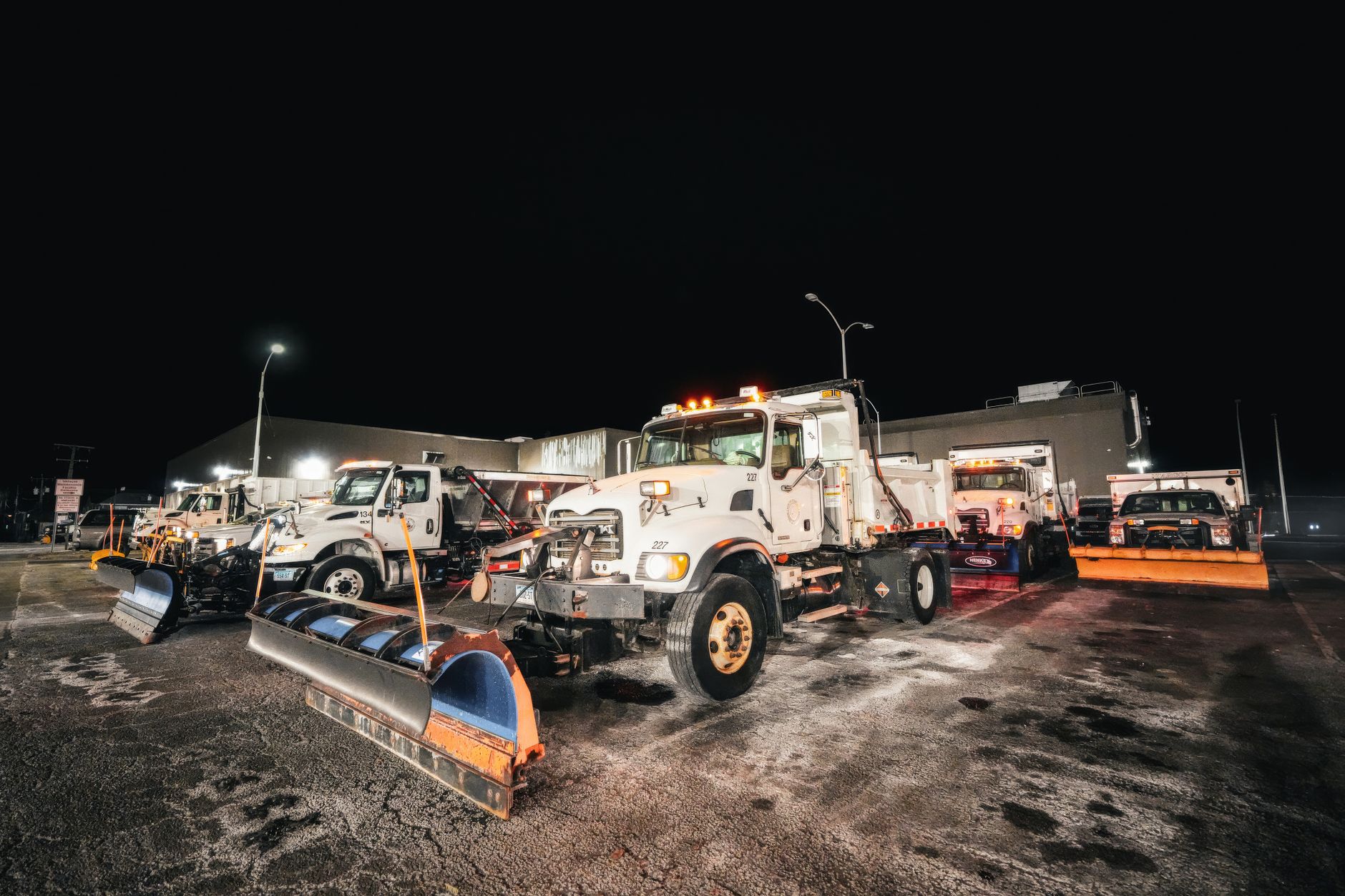
We handle commercial and residential snow across the same West Metro footprint as our lawn routes, all with our own crews and equipment, dispatched around your operating hours. You can see how one of these comes together on our Medina snow contract project. Site walks are free and the right time for one is before the routes are built, not after the first storm. Reach the office here.
Frequently asked questions
What should be included in a commercial snow removal contract?
At minimum: a defined trigger or zero tolerance standard, a response window, a walked site map naming entrances, accessible parking spaces and access aisles, fire lanes, sidewalks, loading docks and stairs, ice management scope, pre-planned snow pile locations, service timing tied to your operating hours, per-event documentation, a certificate of insurance, and a named contact with an escalation path on both sides.
What is the difference between zero tolerance and trigger-based snow service?
A trigger contract dispatches crews once snowfall reaches a set depth, typically one or two inches, and generally involves one pass after the event. Zero tolerance keeps crews maintaining the property continuously throughout a storm so surfaces stay clear the entire time. Zero tolerance costs substantially more and is appropriate for medical buildings, restaurants, senior housing, and any site where the public is entering and exiting during the storm.
Why does documentation matter for commercial snow removal?
Because in a slip and fall claim the central question is what your service standard was and whether it was met on that specific day. Timestamped records of arrival and departure times, areas serviced, materials applied, and conditions at the time are frequently the only usable evidence months after the fact. Your own recollection of a January morning will not carry weight where a contemporaneous service record will.
How much does commercial snow removal cost in the West Metro?
Pricing depends on lot size and layout, the amount of hand work at walks and entrances, service standard, where snow can be piled and whether hauling is needed, and how the site fits existing routes. Seasonal contracts give one fixed number for the winter, which most property managers prefer for budgeting, while per-event billing charges each visit. Site walks and estimates are free.
Where should snow piles go on a commercial lot?
Locations should be mapped before the season based on drainage, sight lines, and which parking spaces you are willing to give up. Piles must not drain across traffic lanes or pedestrian routes, since meltwater running downhill during a thaw refreezes overnight into ice exactly where people step out of vehicles. On constrained lots where piles have nowhere to grow, hauling snow off site is usually more economical than losing parking capacity through March.
Should I ask my snow contractor for proof of insurance?
Yes, and before the season rather than after an incident. Request a current certificate of insurance and confirm the coverage is active. A contractor working your property without adequate coverage transfers risk onto you, which defeats a significant part of the reason for hiring professional service in the first place.