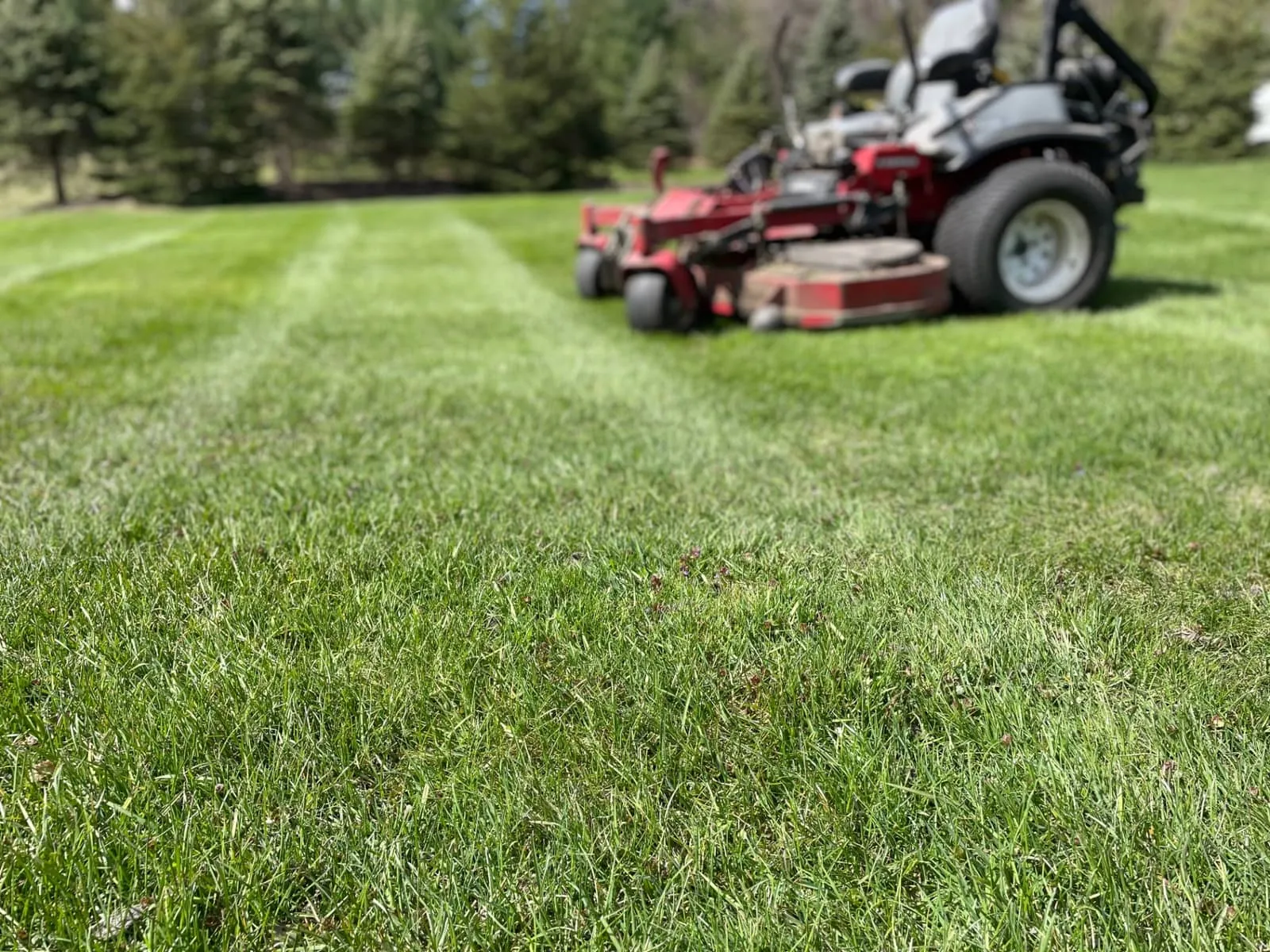
Buffalo is a short drive up Hwy 55 from our Rockford headquarters, and we spend a lot of the season there. Lawns in town have their own set of conditions: lake lots on Buffalo Lake and Lake Pulaski, older yards near downtown with mature trees, and newer subdivisions where the grass is growing on a few inches of topsoil over packed clay.
This guide covers what Buffalo lawns need through the year, where most of the problems start, and which services actually help.
What makes Buffalo lawns different
Wright County clay
Much of Buffalo grows grass on heavy clay or clay loam left behind by glaciers. Clay holds water and nutrients well, but it compacts easily and drains slowly. Roots stay shallow, water runs off before it soaks in, and the lawn struggles in July even when it looked fine in May. We went deeper on this in our post on clay soil in Buffalo and Wright County, but the short version is that core aeration and soil improvement matter more here than in sandier areas.
New developments with thin topsoil
Buffalo has grown a lot, and newer neighborhoods share a common problem. During construction, topsoil gets stripped, heavy equipment packs the subsoil, and a thin layer of topsoil goes back down before sod or seed. The lawn looks good the first year or two. After that, roots hit the compacted layer and stop, and the grass starts thinning no matter how often it is watered.
These lawns respond well to yearly core aeration and a steady fertilization program. They are slow to fix, usually two or three seasons, because you are building soil that should have been there from the start.
Lake lots
Homes on Buffalo Lake and Lake Pulaski deal with a few extra things. Fertilizer needs to stay on the grass and off the shoreline, sidewalks and driveway, because anything that washes off ends up in the lake and feeds algae. Granules that land on pavement should be blown or swept back onto the turf. A strip of unfertilized vegetation along the water's edge helps too.
Lake lots also tend to have more mosquitoes, especially in shaded yards with shrubs and tall grass near the water. Barrier treatments to those resting areas from May through September make a real difference on summer evenings.
A season of lawn care in Buffalo
April: cleanup and first look
Once the snow melts and the ground firms up, a spring cleanup clears out leaves, sticks and debris that sat on the lawn all winter. It is also the best time to check for snow mold, vole trails along fence lines and salt damage at the curb. Rake matted spots lightly so the grass can dry out and grow through.
Late April to May: crabgrass prevention
Crabgrass starts germinating when soil temperatures stay around 55 degrees for several days, which in Buffalo usually lands from late April into mid May. A pre-emergent applied before then stops most of it. Miss the window and you are pulling or spot-treating crabgrass all summer. This first round is the start of our 7-step fertilization program.
Late May to June: weeds and grubs
Dandelions, creeping Charlie and clover show up in force in late spring. Broadleaf weed control at this stage is most effective, and treated weeds typically yellow within 7 to 14 days. Early summer is also when a preventative grub control application goes down. One application covers the full season against Japanese beetle and June beetle larvae, which feed on roots in late summer.
Summer: mowing height and water
Mow at 3 to 3.5 inches through summer. Taller grass shades the soil, holds moisture longer and crowds out weeds. On clay, water deeply and less often, and stop when you see runoff. Let it soak in, then finish later. One deep watering is worth more than several light ones that only wet the surface.
Late August to September: aeration and overseeding
This is the best window of the year for repairing a Buffalo lawn. Soil is still warm, nights are cool and seed has time to root before winter. Core aeration opens up compacted clay, and overseeding right after puts new grass into those holes. Lawns in newer developments benefit from this every fall.
October to November: fall feeding and cleanup
The fall fertilizer rounds focus on root growth and winter hardiness. A fall cleanup removes leaves before snow packs them down on the turf. Keep mowing until the grass stops growing, and finish around three inches.
Which services fit which lawns
Not every lawn needs everything. Here is how it usually breaks down in Buffalo:
- Newer development lawns: fertilization, yearly core aeration and soil improvement to build organic matter in the root zone.
- Older yards with mature trees: fertilization, overseeding with shade-tolerant grass and a careful fall leaf cleanup.
- Lake lots: fertilization applied with care near the shoreline, mosquito and tick barrier treatments and grub control.
- Busy households: weekly mowing on a predictable day, with trimming and blow-down included.
We handle all of it in-house with our own crew and equipment, so the same team that mows your lawn knows what the fertilization schedule looks like. You can see the full list of what we offer in town on our Buffalo service page.
Booking spring service in Buffalo
Spring routes fill up early. The first fertilization round has to go down before crabgrass germinates, and schedules for mowing and cleanups get set in March and April. Homeowners who sign up over the winter get placed on the route before the rush.
The quickest way to see what your lawn will cost is the Instant Estimate button at the bottom right of every page on our site. You outline your lawn on a satellite map and see prices for mowing, fertilization and weed control, aeration, overseeding and more in about a minute. Get an instant estimate any time, or call our office and talk to a real member of the Liberty team.
Frequently asked questions
Does Liberty Lawn & Snow provide lawn care in Buffalo, MN?
Yes. Liberty Lawn & Snow provides lawn care in Buffalo, MN, including fertilization and weed control, mowing, core aeration and overseeding, spring and fall cleanups, grub control and mosquito control. The company is family-owned and based on Hwy 55 in Rockford.
When should Buffalo homeowners book spring lawn service?
Buffalo homeowners should book spring lawn service over the winter or by early March. The first fertilization round with crabgrass prevention needs to go down by late April or early May, before soil temperatures reach about 55 degrees.
Why is my lawn in a newer Buffalo development thinning out?
Lawns in newer Buffalo developments often thin out because the topsoil was stripped during construction and the subsoil was compacted by heavy equipment. Roots cannot grow past the compacted layer. Yearly core aeration, steady fertilization and soil improvement fix this over two or three seasons.
Is lawn fertilizer safe to use on lake property in Buffalo?
Lawn fertilizer can be used on lake property in Buffalo when it is kept on the turf and off the shoreline and pavement. Sweeping stray granules back onto the grass and leaving an unfertilized buffer along the water helps keep nutrients out of Buffalo Lake and Lake Pulaski.
How much does lawn care cost in Buffalo?
The cost of lawn care in Buffalo depends on lawn size and which services you choose. The Instant Estimate tool on the Liberty Lawn & Snow website shows real prices for mowing, fertilization, aeration, overseeding and other services after you outline your lawn on a satellite map.